
Museums · Apps · Augmented and virtual reality · 3D printing

EXCIT3D develops digital offers for museums and cultural institutions. The range extends from interactive 3D reconstructions through the programming and design of VR and AR applications to accessible solutions from the 3D printer. The aim is to make history vivid and accessible to more people.
- Services
- Apps, avatars, AR/VR, 360°, 3D printing, media tables
- Devices
- Smartphone, tablet, VR headset
- Examples
- Kusel, Schloss Burg, Velbert, Remscheid
- Focus
- Ease of use and accessibility
App and software development for museums
Tailored apps and software solutions extend exhibitions digitally, convey information interactively and create new visitor experiences. The applications range from classic museum apps with audio and media guides through AR and VR applications to app-based archiving solutions. We place particular emphasis on ease of use, accessibility and user-friendliness.
Museum apps for indoors and outdoors

Apps open up new ways for museums to guide visitors digitally, on a smartphone, a tablet or in a VR headset such as the Meta Quest 3. Information is prepared for each target group, and content can be updated and extended at any time.
We develop apps for indoor and outdoor use, GPS-guided tours, gamification elements and media stations. An early example is the Schloss Burg AR app (in German) from 2019 with Count Adolf V. as an animated 3D figure.
3D avatars as virtual museum guides

Virtual museum guides in the form of 3D avatars make a museum visit more personal and interactive. They convey knowledge in different languages, tell stories and respond to user input. Avatars are suitable for low-barrier communication and can be integrated into apps, AR and VR applications or media stations.
In the museum app we developed for six museums in the district of Kusel, a total of twelve avatars appear. For the project kick-off in September 2024 (in German) we visited all the museums; the app launched on the Digital Museum Day on 31 May 2026 (in German).
3D printing: tactile models, replicas and teaching models
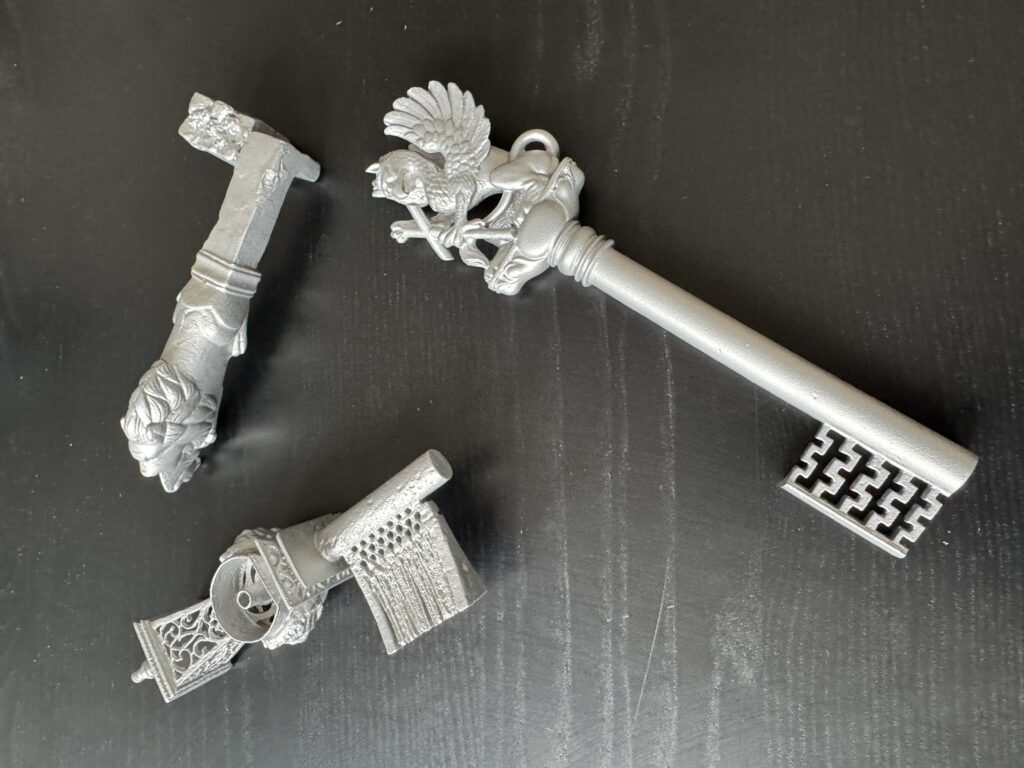
3D printing makes exhibits tangible: as tactile models for visually impaired visitors, as true-to-scale replicas of rare exhibits or as scientific models that illustrate complex relationships. Our 3D printing solutions combine technology with educational value.
In the Deutsches Schloss- und Beschlägemuseum in Velbert, visually impaired visitors can feel exhibits thanks to 3D scanning and 3D printing. For Schloss Burg we printed depictions of Engelbert and four castle models for the new permanent exhibition (in German).
AR and VR: time travel and places that no longer exist
With augmented and virtual reality, museums can take their visitors on journeys through time or make places that no longer exist virtually accessible. AR and VR tours, digital reconstructions and playful elements add digital components to the classic exhibition experience.
Two examples: the app “BJÖRN | Zeitreise Schloß Broich” (in German) guides visitors in Mülheim an der Ruhr through the history of the castle in AR and VR. The Solingen synagogue (in German), destroyed in 1938, can be flown around as a 3D reconstruction in the browser, walked through with a VR headset and placed in AR. More on our page Virtual time travel.
360° tours and virtual exhibitions
360° images make exhibitions accessible outside the museum as well, with images, texts and videos at the individual stations. At Schloss Burg on the Wupper we recorded virtual tours with 360° 3D cameras (in German). For the Zentrum für Verfolgte Künste in Solingen we created the virtual exhibition “Und laut zu sagen: Nein!” as a 360° tour.
More examples from museums
In the German Röntgen Museum in Remscheid, Wilhelm Conrad Röntgen himself guides visitors through his discovery as an animated 3D model in augmented reality; for the museum we also created 3D models and prints to inform people about the coronavirus (in German). For the Kunstmuseum Solingen we scanned works of art and staged them digitally (in German).
Media tables with their own content management
For interactive media tables, EXCIT3D develops content management systems with which museums maintain texts, images, videos and 3D objects themselves. The presentations stay up to date and expandable without programming for every change.
Digital archiving of exhibits and texts
With our digital archiving solutions, museums capture and manage exhibits, content and exhibition texts quickly and conveniently and prepare them for digital presentation. Intuitive user interfaces and flexible data maintenance benefit museum staff and visitors alike.
The museum solutions at a glance
- 01App and software development: museum apps, audio and media guides, GPS tours, media stations
- 02360° tours and virtual exhibitions
- 03Interactive media tables with a content management system
- 043D avatars as virtual museum guides
- 053D printing: tactile models, replicas, scientific models
- 06AR and VR: time travel, tours, digital reconstructions
- 07Digital archiving of exhibits, content and exhibition texts
A team of 3D artists, developers, designers and UX specialists supports museums from the first idea to the finished application, with hosting, support and on-site integration on request, for small town museums as well as large institutions.
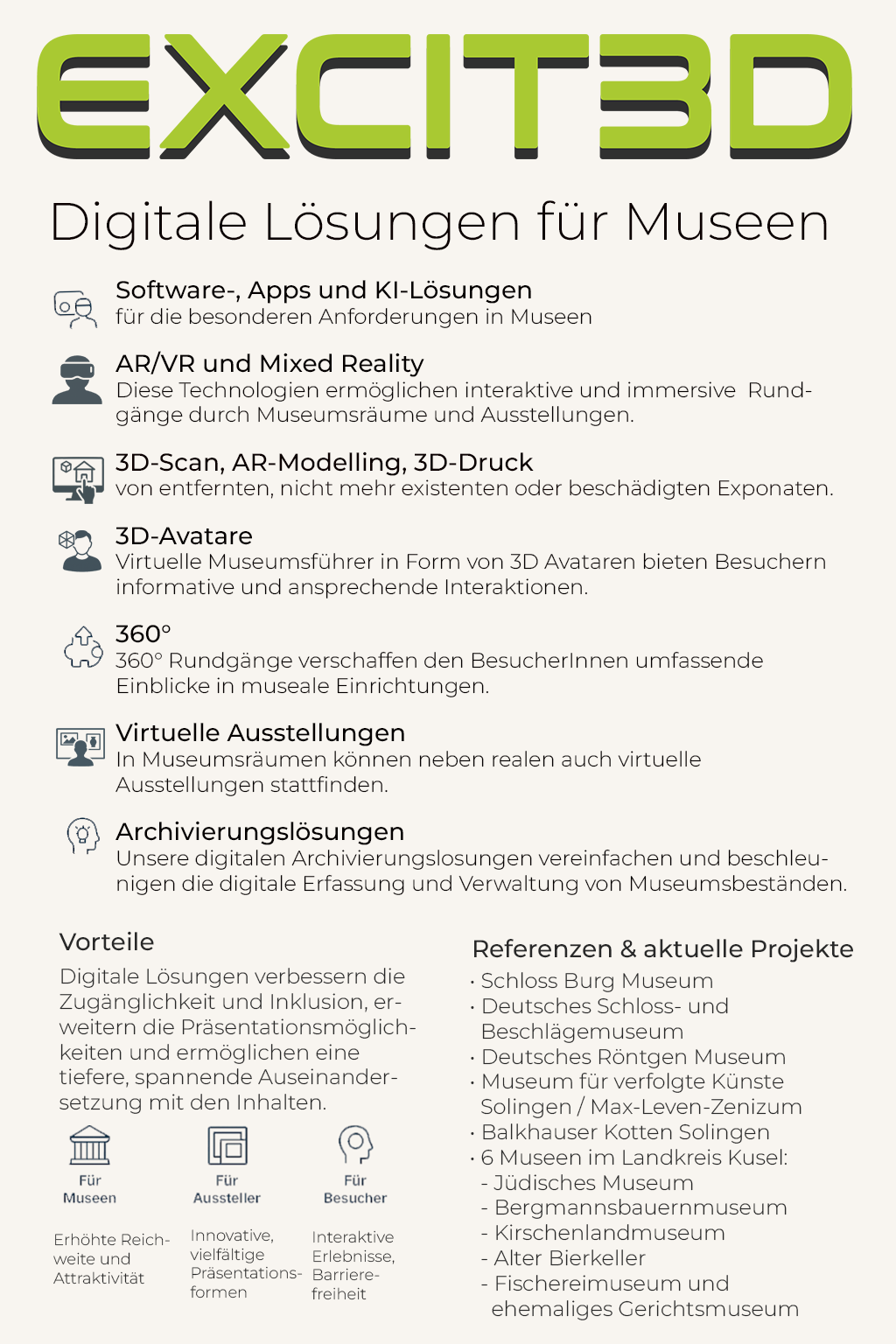
Digital offers for your museum
We advise on apps, avatars, AR, VR, 3D printing and archiving and develop solutions for individual museums or for several museums in a shared app.
Museum solutions · EXCIT3D GmbH, Solingen
info@excit3d.de · +49 212 26049777
Frequently asked questions
Which digital solutions does EXCIT3D offer museums?
Museum apps with audio and media guides, 3D avatars as virtual museum guides, AR and VR applications, 3D printing for tactile models and replicas, and digital archiving solutions.
How does 3D printing support accessibility in museums?
Tactile models made by 3D scanning and 3D printing let visually impaired people experience exhibits, for example in the Deutsches Schloss- und Beschlägemuseum in Velbert.
Can content be changed later?
Yes. Content in the apps can be updated and extended at any time. For exhibits and exhibition texts there are archiving solutions with simple data maintenance.
More on this topic: Virtual time travel · Augmented reality · 3D printing. Topics: museum, museum app, 3D avatars, augmented reality, virtual reality, 3D printing, accessibility, archiving
More projects by EXCIT3D
Annual review · 2024 Review 2024 The most successful year in EXCIT3D’s history so far. From the Willy Brandt bust to the virtual Goslar Cathedral: all projects of the year. Annual review · EXCIT3D GmbH, Solingen 2024 was by far…
Weiterlesen →AI · Virtual reality · Construction AI Studio Munich · 2024 AI on the construction site, experienced in VR. A VR demonstrator on construction site logistics, developed with Fraunhofer IAO. The Construction Pioneer · EXCIT3D GmbH, Solingen · © EXCIT3D…
Weiterlesen →Virtual reality · 360° · Education for sustainable development Nicaragua · Honduras · Solingen · 2024 Climate protection projects from Central America in 360° and VR. Young people from Nicaragua and Honduras show in 360° films how they reforest mangroves…
Weiterlesen →About EXCIT3D GmbH
We develop applications where 3D technology, augmented reality, virtual reality and software development meet. For industry, culture and public clients we build solutions from the first idea through 3D data processing and user interface to live operation. We are based in Solingen, Germany.