
Augmented reality for culture, retail and industry
Augmented reality (AR) overlays 3D models, figures and information onto the camera image of a smartphone, tablet or headset. EXCIT3D develops AR apps and WebAR, among others for city tours in Goslar, Uslar and Wassenberg, for six museums in the district of Kusel, for the downtown treasure hunt ARcadia and for RWE Renewables.
What is augmented reality?
Unlike virtual reality, which places us in a completely digital world, augmented reality overlays the real world with virtual elements that are visible on our devices.
AR runs as an app for iOS and Android or as WebAR directly in the browser, without a download. Which option fits depends on how often and how long the application is used and which functions it needs. Projectors can also serve as the technical basis, for example our 3D-printed hologram projector.

The benefits of augmented reality
What AR is used for in our projects.
Applications of augmented reality
Selected projects by industry.
Industry and trades
In October 2021, we developed an AR app called “RWE AR Experience” for RWE Renewables. A rotating, talking wind turbine provides users with information about renewable energy. Users can place a 3D wind turbine on any surface – implemented with codecentric AG.
In October 2022, this was followed by the WebAR solution “Experiencing Renewables” – a virtual wind turbine directly in the browser, without an app download. The 3D turbine can be placed on tabletops via smartphone.


Medicine and science
In medicine and science, AR shows complex structures spatially, for example bone fractures before an operation or phenomena of particle physics. For the LHC ErUM-FSP office, we developed the AR app “The Particle Universe”, presented in 2024 for the 70th anniversary of CERN.
In April 2019, EXCIT3D worked with RIMASYS and the Städtisches Klinikum Solingen on a project for a science documentary by the Austrian broadcaster ORF on “Medicine of the Future”. Complex bone fractures were 3D-printed ahead of operations and made available to the surgeon both as a physical model and as an AR and VR model. This helped make operations better, faster, more cost-effective and more patient-friendly.
RIMASYS, the world’s only manufacturer of realistic fractures in human specimens with a closed soft tissue envelope, enabled realistic practice for surgeons in the “operating room of the future”. Patients benefit from a faster, more efficient operation and a reduced risk of infection.
Architecture and real estate
The “Europagarten” in Herne combines architecture and digital technologies. The app developed for E-Gruppe places planned buildings in AR via smartphone. The partnership was extended with further projects: the Sehnde-Ost logistics hall and the Kaiserquartier in Herne.
The reconstruction of the Solingen synagogue makes the synagogue, built 150 years ago and destroyed in 1938, accessible again – as an AR model, on a website or via a VR headset.


Tourism and cultural heritage
In tourism, AR shows historical buildings and people at the place where they stood. Schloss Broich in Mülheim an der Ruhr is one of the oldest Carolingian castle complexes north of the Alps. In the app “BJÖRN | Zeitreise Schloß Broich”, the Viking Björn guides visitors through the history of the complex at eight stations, from the defensive castle of 883 to 1787. AR portals open 360° scenes of the respective era.
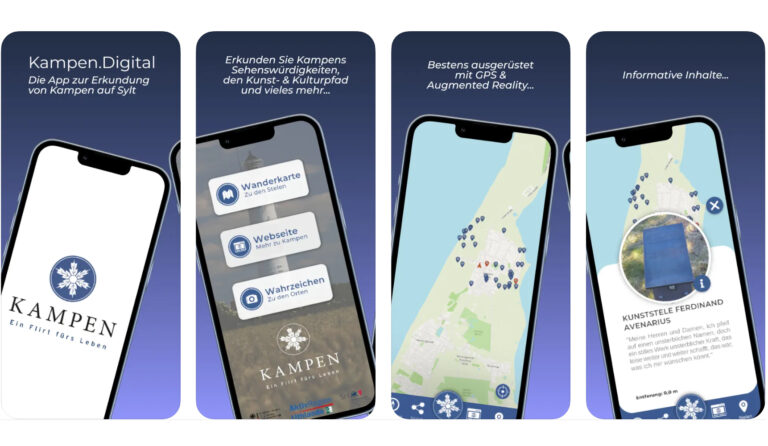
The Kampen.Digital app for Sylt offers a culture and art trail with 40 steles on personalities such as Thomas Mann and Ernst Ludwig Kirchner – including a children’s trail with the “Sylter Puk”.


Current AR projects 2026



Art and culture
With AR, works of art can be shown as 3D models on smartphones and tablets, also outside the exhibition space.
In the “Mater Dei” project, an assemblage by the artist Yvette Endrijautzki was modeled on the computer, 3D-printed and is presented as an AR model – accessible via smartphones and tablets without a special app.
The pop art artist Niloc Pagen uses AR to make his colorful works of art accessible digitally.

Retail and e-commerce
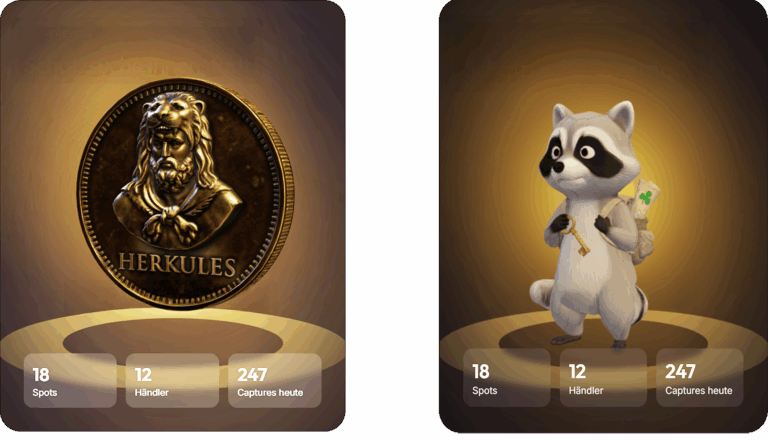
In retail, AR brings promotions and products to the smartphone. With ARcadia, we developed a WebAR treasure hunt for downtown areas and shopping centers: passers-by scan a QR code, collect 3D treasures and redeem them at the retailer as a voucher, without an app download and without registration.
The “try before you buy” experience in online retail lets customers place products such as furniture in their own room as a 3D model before buying.

Projects & applications
Selected projects and products in this area, each with its own page.




Start your AR project with us
Tell us where and for whom the AR application will be used. We will suggest whether an app, WebAR or a mixed reality solution is the right fit.